We experience a constant struggle to keep a level playing field on the one hand and not putting a significant burden on industry to constantly update their LCA/EPD datasets. What is the current status? An EPD is 5 valid and most, if not all, databases follow that period, also the Dutch NMD. That means once calculated and verified I can use the result for 5 years. When during this period something changes in the LCA rules (PCR) or background dataset (for instance the ecoinvent version) my calculation would be outdated, but still valid.
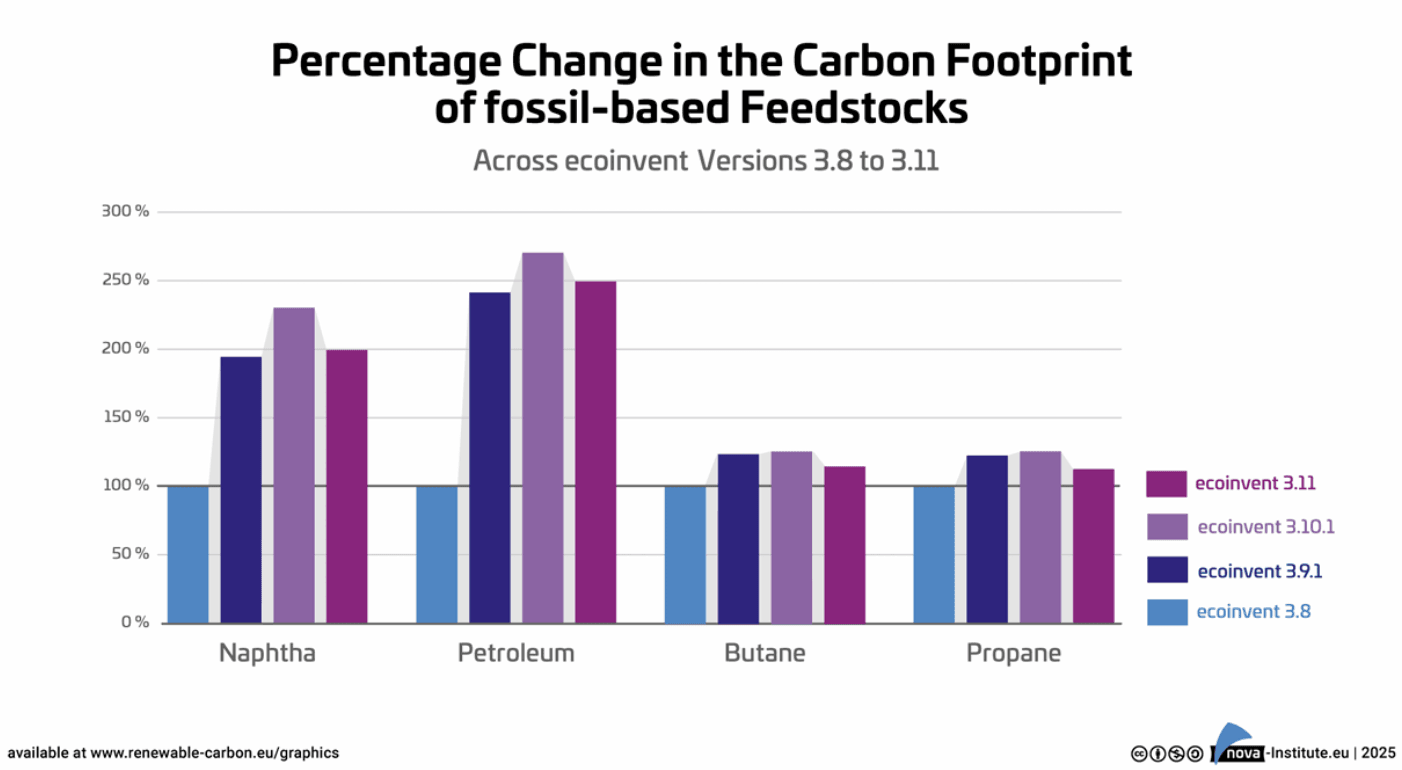
That changes in ecoinvent versions can have a significant impact is known. For instance, the change in how oil refinery’s are handled changed in ecoinvent resulting in significant impact on environmental performance of the resulting output flows:
Source: Increased Methane Emissions in Crude Oil and Natural Gas Supply: Implications for the Carbon Footprint of Petrochemicals – RCI Report (October 2025) | Renewable Carbon Publications
For the better?
Any change resulting in better results, it is up to the manufacturer to decided whether to update (cost) or not, depending on the impact. That would be a valid business decision (although it will feel that the system forces you to make extra costs).
For the worse?
Any change resulting in worse results, I am not compelled to update my LCA/EPD. And that is the problem at hand. Manufacturers who need to update, due to expiration of their EPD or new products entering the market place, will be at a disadvantage, creating an unlevelled playfield and this would not be accepted in any tendering process (for instance in public procurement).
There are 2 solutions:
• Fix the background dataset on a specific database and version in your (National) method, like The Netherlands have done in their annex to the EN 15804 (www.milieudatabase.nl)
• Fix it in the tendering rules by pointing to a specific background database and any relevant PCR.
The first solution works in The Netherlands, although the disadvantage is that we always work with a outdated database version (currently we are still on ecoinvent 3.6) and you still want to switch at one point (because the background database becomes to much outdated). At that moment the problem still occurs, but in a more controllable way, you can prepare the switch and it will take place on a chosen moment in time (and this moment is published well ahead). Doing so we skip a number of database versions, maybe that is the biggest gain: there are less changes and stable periode in between is longer. Products in the National database have been building up two datasets for several years now, so the whole database can switch from ecoinvent 3.6 to ecoinvent 3.9.1 at one moment (1st July 2026).
The second solution would fix it for every tender in their own desired way. When done properly this would guarantee the level playing field. The disadvantage seems to be that every contract owner needs to understand the specific rules and conditions how to do this and how to enforce this. Since this would have to be enforced on every tender, it seems to put a very significant administrative burden on the tendering process. For big tenders this could perhaps work, but for all the small tenders that are executed every day, this seems to be too much. When you think this through the solution would be a national harmonization for tendering, resulting in more or less the same situation as the first solution.
With R<THINK we have been supporting LCA/EPD for tendering for 10 years now and we think this is a valuable lesson to share now that more countries will be considering to use EPD in public procurement tendering.
.svg)