
Can you reuse your current EPDs when your product group moves under the new CPR (2024)?
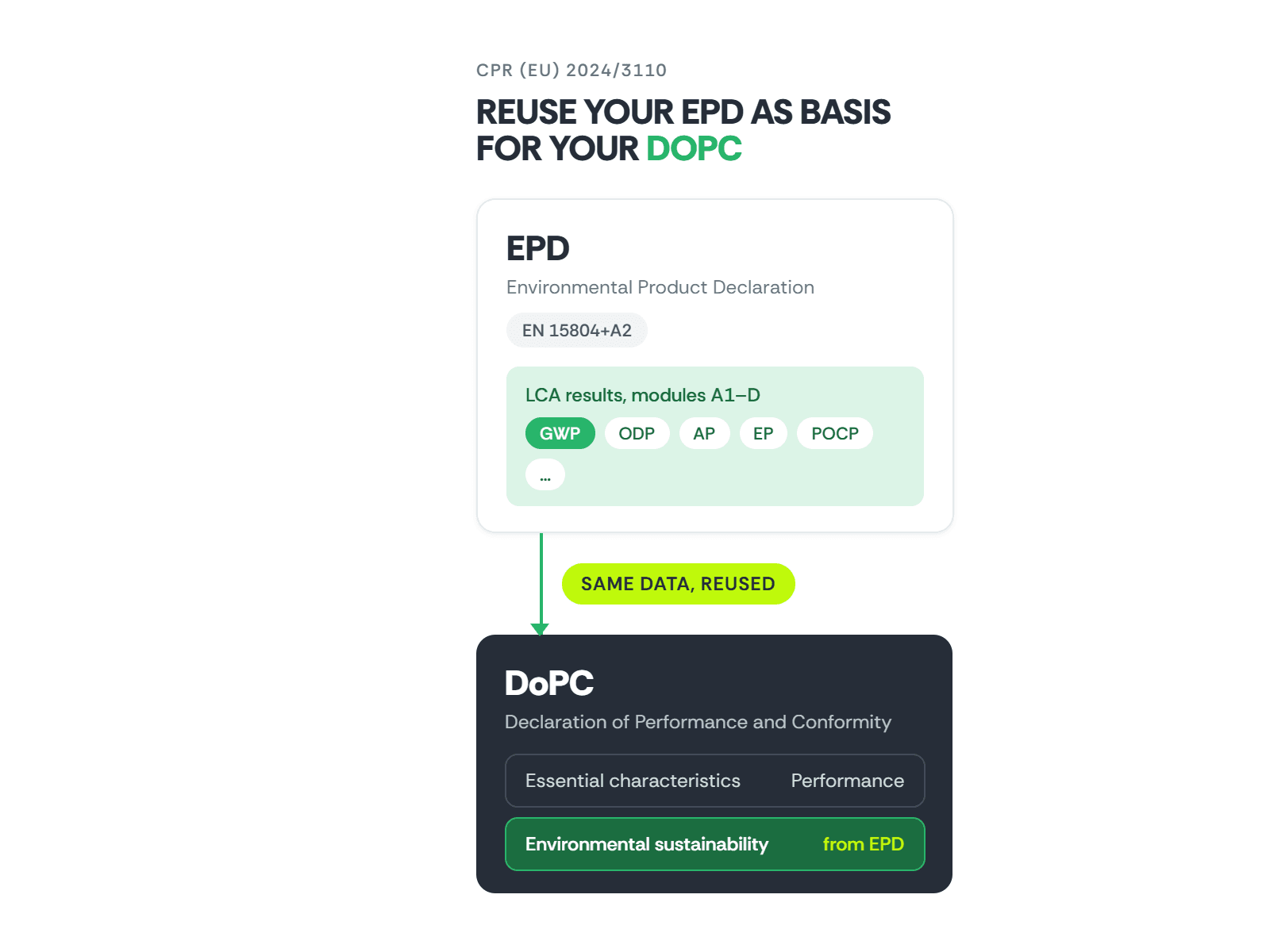
The short answer is no. You do not throw away your work. But you also cannot simply copy an existing EPD onto the new declaration and call it done. Your data keeps its value as the technical foundation; what changes is how that data is verified, declared and shared.
What stays the same
The methodology behind your EPD is exactly the methodology the CPR relies on. The regulation's environmental essential characteristics — the predetermined set in Annex II — line up with the impact categories of EN 15804, and the declared values are calculated against EN 15804:2012+A2:2019+AC:2021, the same core product category rules your current EPD already follows. For concrete, EN 16757 remains the product-specific layer, including the 100-year reference service life from its Annex AA. The CE marking stays, products under a harmonised standard still carry it, and the familiar AVS levels (1+ through 4) remain in place.
In other words, the life cycle assessment you commissioned, the inventory you built and the indicator set you reported are not wasted. They are the starting point for your declaration under the CPR.
What genuinely changes
Three things are new, and together they explain why this is not a copy-paste exercise.
First, the declaration itself. The Declaration of Performance (DoP) becomes the Declaration of Performance and Conformity (DoPC). You now declare not only what your product does, but also that it conforms to EU law — and environmental data becomes a mandatory part of that declaration. It starts with Global Warming Potential, extends to the thirteen core indicators of EN 15804+A2, and from 2031 onward adds the six further indicators.
Second, the verification route. The CPR introduces assessment and verification system 3+ for environmental sustainability, and it is mandatory. Verification by a Notified Body is no longer optional — even products that previously sat under system 4 now fall under 3+ for the environmental part. For company-specific data this includes an initial inspection of your manufacturing plant. The verification you already arranged through an EPD programme is a strong head start, but it does not automatically satisfy AVS 3+; expect it to be extended into product-related verification against the harmonised standard of your product group.
Third, the digital format. Your environmental data has to become machine-readable, structured according to ISO 22057, so it can sit inside the Digital Product Passport (DPP) that the CPR requires. The DPP register opens in July 2026 for voluntary entries, with the obligation to use the system following later. A PDF on your website is no longer enough on its own.
The national rules question
Here the direction of travel works in your favour. Under the new CPR, European standards lead. National additions — such as the Dutch determination method behind the NMD — may not conflict with the harmonised standards. There is less room for country-by-country interpretation than before, which over time means less duplicated work across the Netherlands, Belgium and France rather than more. Where your national declarations align with EN 15804+A2, that alignment carries forward.
What this means for you
Treat your existing EPDs as an asset, not a liability. The substance carries over; the work ahead is verification under AVS 3+, mapping your data onto the DoPC for your product group, and getting it into a machine-readable form for the DPP. The manufacturers who come through this smoothly are the ones who stop managing EPDs as isolated documents and start managing the data behind them — once, well structured, ready to feed an EPD, a DoPC, a Corporate Carbon Footprint and CSRD reporting alike.
R<THINK is fully ready for the CPR. We have implemented the ISO 22057 for digital data delivery. We have the datasets you need and are pre verified for EN 15804. We also have deep understanding of the EN 16757 (PCR for concrete), as one of our team members participated in the task group drafting it.
We're happy to walk through where your current EPDs stand and what the move under the CPR asks of you.